Fiscal rulesGuide
An online shop with no fiscal device: the article 3(17) regime
The conditions, the Appendix 18a document with its QR code, the monthly Appendix 38 audit file, and what you still file yourself.
In this article7 sections
What the regime actually is
The ordinary rule is that a card payment is treated as cash-like and requires a fiscal receipt. For e-commerce, Ordinance H-18 makes an exception: for remote card payments a shop may skip the fiscal device if it instead issues a specific document for every sale and files a monthly audit file.
The trade is about transparency. A fiscal device reports to the revenue agency in real time; here the same visibility comes from numbered documents whose numbering cannot have gaps, plus a monthly file containing every order in the period. For a shop selling only online, the second is considerably cheaper and simpler than a cash register.
The conditions, and one outdated rule
This is where many shops give up, over a rule that no longer applies. Until 26 February 2021 the regime required the shop to accept no other payment that would itself require a fiscal receipt. The ordinance has deleted that condition. Today a shop can apply the regime to its remote card payments while issuing a fiscal receipt for cash on delivery that is not a ППП and for cash paid on collection: from its own device, or through a courier that issues it in the shop’s name. Bank transfer and cash on delivery as a ППП need no receipt at all.
The remaining conditions are about the software and the document: the shop must meet the ordinance’s requirements on data integrity and authentication, and the document itself must carry a unique ten-digit ascending number, merchant identification, references to the order and the payment transaction, the item lines with their tax groups, the totals, and a QR code per Appendix 18a.
One practical caveat: the Appendix 33 form on the revenue agency’s portal still asks the regime question in its old wording. If you take cards and payments with a fiscal receipt, agree the answer with your accountant, and with the agency if needed, before you file.
In ZweiHost this is not something you check by hand. Settings carries a page that reads your live configuration (which couriers are enabled, which payment methods they allow, whether store pickup is configured) and says plainly which sales can go under the regime and which payments need your own fiscal receipt, with a link to the setting that controls each.
The Appendix 18a document
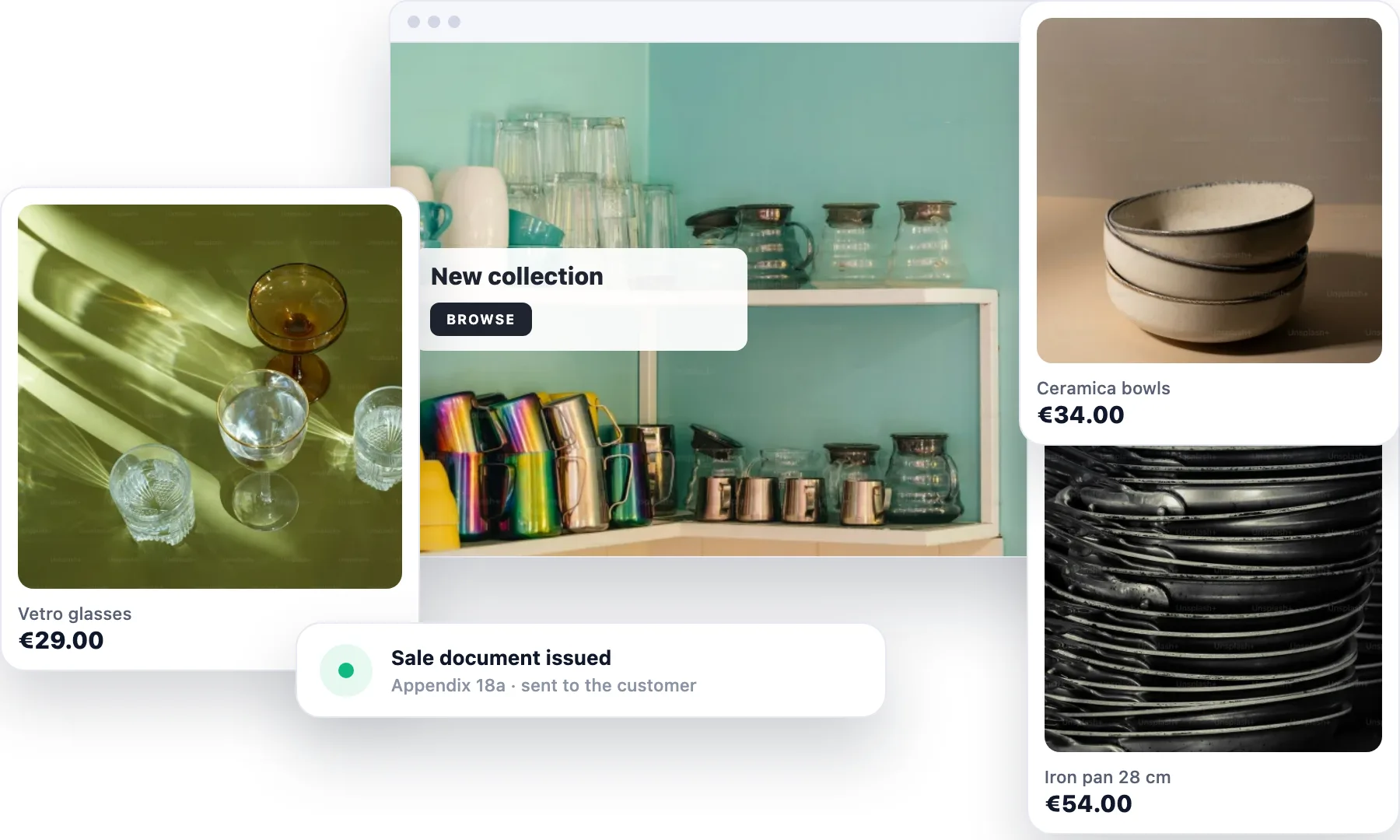
On every confirmed payment under the regime the customer receives a sale registration document. Its numbering is separate from your order numbers and must have no gaps, which is why it runs off its own counter rather than the order number, which burns a value on a failed order.
The QR code is not decoration. Its contents are precisely specified: the shop’s number with the revenue agency, the order number, the transaction reference, the date, the time and the total. ZweiHost generates it in that format and sends the document to the customer as a PDF attached to the order email; you can also issue and download it manually from the order.
The monthly Appendix 38 file
Once a month you file a standardised audit file containing every sale for the month, not only the card ones. Each line carries a net price, a VAT rate and amount, and a gross total; shipping is its own line; and the payment method carries its own code. Refunds executed in the month go in too.
The format is strict and is validated against the revenue agency’s official schema. ZweiHost builds the file from your orders and hands it to you as a download with a month picker, telling you first how many orders and refunds it will contain and what is missing from your settings if anything blocks it. Filing goes through your own tax portal: that is the step that stays with you or your accountant.
“Online sales without a cash register”: when the courier issues the receipt
The article 3(17) regime settles card payments. For cash on delivery there is another route, and it carries almost the same name: “Online sales without a cash register” is an Econt service in which, under a separate agreement, Econt issues the fiscal receipt and reports the sale in your name when it delivers the parcel. The receipt is still owed: it is simply issued by the courier rather than by a fiscal device of yours.
The conditions are specific. The parcel is prepared electronically (in e-Econt or through an integration module in the online shop) and carries the agreement number as the cash-on-delivery payout option, plus an item list with the name, unit price and quantity of each item (with a tax group, even if you are not VAT-registered), or your invoice number and date. Econt cites Ordinance H-18 as the reason. A parcel without the agreement or without these details is ordinary cash on delivery, and its receipt stays with you. The service is free, the collected amounts are paid out by bank transfer or in cash as the agreement sets, and when a refund to the customer goes by bank transfer, Econt’s receipt needs no storno. In ZweiHost you choose “Econt issues it for me” in the Econt settings and pick the agreement, and the waybills carry it and the item list by themselves.
Speedy offers the same under the name “Касов бон за наложен платеж”: if your contract includes the service, Speedy issues the receipt for you from the items on the waybill: at most 20 per receipt, delivery included. In ZweiHost that is the “Speedy issues it for me” choice in the Speedy settings. Which courier offers what, and on what terms, is collected in the reference on fiscal receipts for cash on delivery.
The two routes combine. A shop that takes cards under the article 3(17) regime, cash on delivery through a courier that issues the receipt in its name, and bank transfer, and takes no cash on collection, can run without a fiscal device of its own: for cards it issues the Appendix 18a document, for cash on delivery the receipt comes from the courier, and a bank transfer needs no receipt. That is a combination of separate rules, not an express permission in the ordinance, so discuss it with your accountant before you give up the fiscal device, and agree with them the answer to the regime question in Appendix 33.
What stays with you
First of all the Appendix 33 declaration: the e-shop information filed through the tax portal with an electronic signature or PIN before sales begin. Some of its fields are our facts, not yours: the software name and version, where the site is hosted, where the database sits. ZweiHost pre-fills them so that you or your accountant can submit them.
And the decision whether to enter the regime at all. If card payments are a small share of your turnover, the simplest route may be not to accept them: a shop taking only bank transfer and ППП cash on delivery owes a receipt on nothing and has no monthly obligation (through ZweiHost no courier collects cash on delivery as a ППП today). That is a perfectly legitimate choice, not a workaround. Which payment method needs a receipt is in the fiscal-receipt reference for online shops.
Want the exact price for your shop?
Three plans at a fixed price, with no commission. Pick one and try it free for 30 days.
Solo
€16/mo excl. VAT
- 50 products
- 1 language · 1 admin
- Cash on delivery and bank transfer
Pro
€34/mo excl. VAT
- 500 products
- Couriers: Econt and Speedy
- Promo codes and wholesale prices
BusinessPopular
€49/mo excl. VAT
- 5,000 products · 3 languages
- Card payments (Stripe)
- More couriers: Sameday, BOX NOW, Pigeon
Prices exclude VAT, with yearly billing. 30 days free, no card, no contract.
See the full comparisonFrequently asked questions
Can an online shop operate without a fiscal device?
Yes, in two ways. Either by accepting only payments that require no receipt at all: bank transfer and cash on delivery as a ППП (through ZweiHost no courier collects cash on delivery as a ППП today). Or, if it also takes cards, by working under the article 3(17) regime: instead of a fiscal receipt it issues a sale registration document under Appendix 18a and files a monthly audit file under Appendix 38.
What are the conditions for the article 3(17) regime?
The shop accepts remote card payments; the software meets the ordinance’s requirements; the document for every sale under the regime carries a unique ten-digit ascending number and the prescribed QR code; and the monthly audit file is filed. Since 26 February 2021 the ordinance no longer requires the shop to accept no other payments with a fiscal receipt: cash on delivery without ППП and cash on the premises simply keep needing one.
What is Appendix 18a?
The sale registration document that replaces the fiscal receipt under this regime. It is issued for every sale and carries a unique ten-digit number with no gaps, merchant identification, the item lines with their tax groups, the totals, and a QR code with precisely specified contents. ZweiHost generates it automatically on confirmed payment and emails it to the customer as a PDF.
What is Econt’s “Online sales without a cash register” service?
A service in which, under a separate agreement, Econt issues the fiscal receipt and reports the sale in your name on a cash-on-delivery delivery. It is free, but the parcel must be prepared electronically (in e-Econt or through an integration module), with the agreement number and an item list, or your invoice number and date. It covers cash on delivery through Econt only: card payments go under the article 3(17) regime or with a fiscal receipt, and a bank transfer needs no receipt.
Does ZweiHost file the Appendix 38 file for me?
No. We build the file from your orders and hand it to you as a per-month download, validated against the official schema. The filing itself goes through your own tax portal with an electronic signature or PIN and remains your obligation or your accountant’s. ZweiHost has no access to your tax portal and cannot file on your behalf.
Does the regime apply if I also have a physical shop?
Yes, for the card payments in your online shop. Sales in the physical shop keep being registered with a fiscal receipt from the device there, and the same goes for store pickup paid in cash. What matters is that the sales are clearly separated: which go through the online shop under the regime and which are registered with a fiscal receipt. Discuss that separation with your accountant before relying on the regime.
Verified as of 8 October 2026. This article is general information, not legal or tax advice. Ordinance H-18 changes often, and the rules that apply depend on your activity, VAT registration and courier contracts. The verification behind the date above was done against public sources: the КРС registers, the revenue agency and the couriers’ own general terms. Confirm anything here with your accountant before relying on it.